


Colour Measurement of Beverages and Liquid Food: First Impressions Count
Colour is one of the first quality attributes that consumers notice. Even before a beverage is opened, smelled, or tasted, its appearance conveys an impression of freshness, flavor, recipe, and brand quality. Especially for juices, soft drinks, beer, wine, milk-based beverages, smoothies, and plant-based alternatives, the visual impression plays a key role in determining whether a product inspires trust.

Whether it’s clear sports drinks or soft drinks, opaque fruit purees and smoothies, or all kinds of milk and milk-based beverages, as well as coffee or tea, HunterLab has the right analyzer for every type of beverage to ensure the highest quality.
Why Objective Colour Measurement Is So Important in Beverage Production
Any discrepancies are particularly noticeable when beverages are sold in transparent bottles, glasses, or PET packaging. A slightly darker juice, a cloudier iced tea, or a slightly different colour in an energy drink can raise doubts in customers’ minds: Is the recipe the same? Is the product fresh? Was it produced correctly?
►For manufacturers, this means that colour cannot be left to chance. It must be measurable, reproducible, and controllable throughout the entire process.
Limits of visual assessment
Human perception is subjective and is influenced by lighting conditions, fatigue, or individual differences. For this reason, more and more companies are turning to instrumental colour measurement to achieve reproducible and standardized results.

Especially with beverages in transparent bottles or glasses, a visible difference in color can immediately raise doubts about freshness, the recipe, or product quality.
In practice, color variations can occur in many areas. Raw materials vary depending on their origin, degree of ripeness, or season. Mixing processes, temperature, concentration, filtration, storage, and packaging can also influence the product’s appearance. What still looks acceptable in the lab may show visible variations during ongoing production or during final bottling.
Visual inspections are often insufficient for this purpose. The human eye is sensitive but subjective. Lighting conditions, one’s condition on a given day, experience, and the environment all influence the assessment. Instrumental colour measurement provides an objective basis here: It transforms a subjective impression into clear measured values, tolerances, and documentable quality criteria.
This makes it possible to detect deviations early, reliably compare batches, and make approval decisions based on defined standards.
Colour Inspection—From Receiving to Filling
A consistent product color isn’t just achieved at the end of the production line. It is the result of rigorous quality control throughout all stages of production.
Colour measurement helps objectively evaluate raw materials and ingredients as early as the goods receipt stage. In process control, it enables faster detection of deviations in formulations or mixing. During final batch release, the product is checked to ensure it meets the specified color criteria.
This offers clear advantages for manufacturers: fewer visible fluctuations, more consistent product quality, better comparability between batches and locations, and traceable documentation for quality management.
Colour, Clarity, and Turbidity: Making Quality Visible
When it comes to beverages and liquid food, it’s not always just about the color. Depending on the product, clarity, transparency, opacity, or cloudiness can also play a crucial role.
Clear apple juice is evaluated differently than naturally cloudy fresh-pressed juice. A cola beverage has different requirements than a plant-based milk drink. Smoothies, purees, soups, and baby food, in turn, have different viscosities and surface properties than water, syrup, or concentrates.
That is why it is important to adapt the measurement solution to the sample. HunterLab supports colour measurement of transparent, translucent, and opaque samples—from thin beverages to thick sauces or purees.
Typical applications include fruit and vegetable juices, nectars, concentrates, soft drinks, energy drinks, iced teas, sports drinks, beer, spirits, liqueurs, wine, dairy products, plant-based milk alternatives, yogurt drinks, coffee and cocoa beverages, as well as liquid food such as soups, smoothies, baby food, and purees.
A Focus on Regulatory Requirements and Documentation
Regulatory requirements also make reproducible colour data valuable. In beverage and food production, regulations regarding additives, colorants, and labeling, among other things, play a role. Objective colour measurement does not replace regulatory testing, but it supports the documentation of process deviations and enables rapid adjustments when measured values fall outside defined tolerances.
Visual inspection is also becoming increasingly important in the packaging industry. Rising requirements for recycled content in single-use plastic beverage bottles can affect the colour and transparency of the packaging. This is precisely where transmission measurement helps to reliably monitor visual properties such as color, light transmission, and haze.
These spectrophotometers accurately and reliably measure the colour values of beverages and liquid foods:
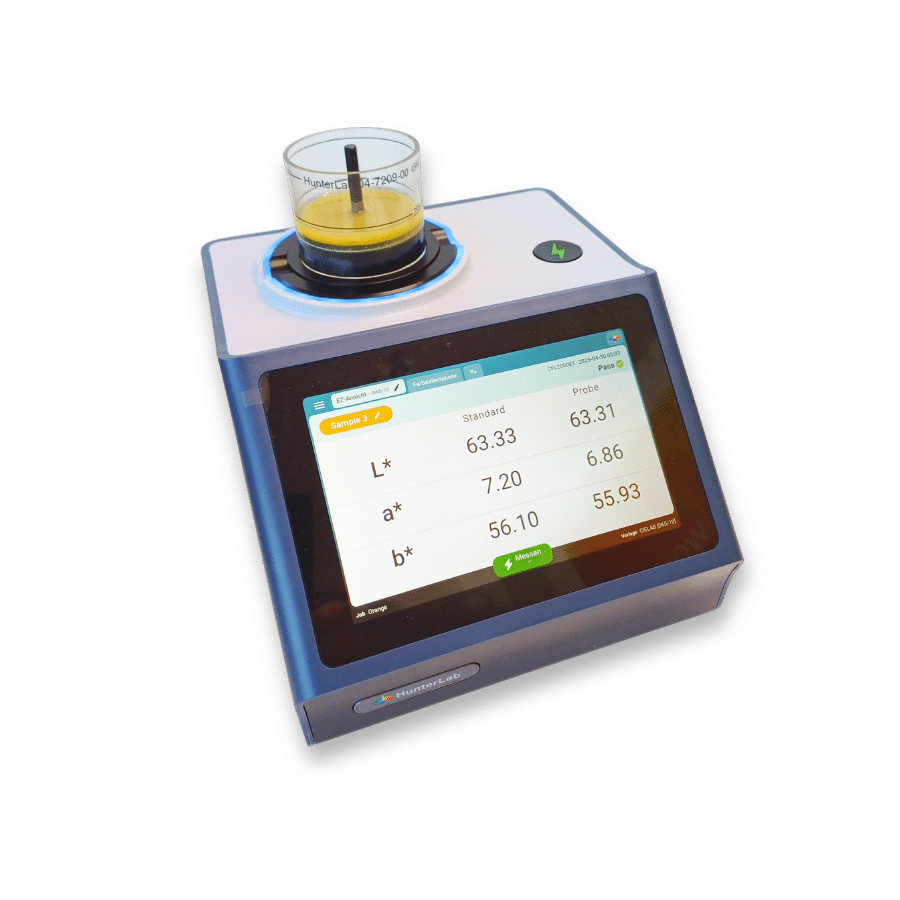
ColorFlex L2 – Reflectance
When used with the appropriate Ring & Disc set, the ColorFlex L2 is the ideal instrument for colour measurement of liquids ranging from translucent to opaque. Smoothies, fruit juices, concentrates, baby food, purees, and fruit spreads can be measured easily and without hassle. CIE L*, a*, b* values, as well as specific indices for citrus, coffee, or tomatoes, are just as easy to determine.

Vista L2 – Transmission
Transparent and translucent samples are measured in different cuvettes or vials. Preforms and PET bottles can also be analyzed using the Vista L2.
FAQ - Frequently Asked Questions About Colour Measurement in Beverages
Why is colour so important in beverages and liquid food?
Colour is one of the first quality characteristics that consumers notice. Especially with beverages in transparent bottles or glasses, a visible variation in colour can immediately raise doubts about freshness, formulation, or product quality. A consistent colour therefore builds trust in the product and supports a clear brand identity.
What are the benefits of instrumental colour measurement in beverage production?
Instrumental colour measurement makes colour objective, comparable, and reproducible. Manufacturers can detect variations in raw materials, mixing processes, or batches early on, monitor defined tolerances, and base product approval on measurable colour data. This transforms a subjective visual assessment into a reliable foundation for quality assurance.
At what stages of the production process can colour measurement be used?
Colour measurement can be used from raw material receipt through formulation and process control all the way to final batch release. Even raw materials and ingredients can be objectively evaluated. During production, color measurement helps detect mixing deviations or process fluctuations at an early stage. Before filling, it supports batch release based on defined colour standards.
What types of samples can be analyzed for beverages and liquid foods?
Typical applications range from fruit and vegetable juices, nectars, concentrates, soft drinks, energy drinks, iced teas, and sports drinks to beer, wine, spirits, and liqueurs. Dairy products, plant-based milk alternatives, yogurt drinks, coffee and cocoa beverages, as well as liquid foods such as smoothies, soups, purees, and baby food can also be measured using colorimetry. Learn more about beverage measurement here.
Can clear, cloudy, and opaque liquids be measured?
Yes. Depending on the sample and the measurement task, transparent, translucent, and opaque liquids can be measured. This is important because clear apple juice, naturally cloudy fresh-pressed juice, a smoothie, and a plant-based milk drink each have different requirements in terms of colour, transparency, opacity, and turbidity. The appropriate measurement solution therefore always depends on the product, sample form, and quality objective.
When is the ColorFlex L2 suitable for beverages and liquid food?
The ColorFlex L2 is ideal for manufacturers who need objective colour data to ensure consistent batch quality. It is designed for beverages, smoothies, and liquid food and supports the measurement of various sample types with appropriate accessories, such as the Ring & Disc Set. For industry-specific applications, metrics such as Citrus Scores, Tomato Scores, or EBC values may be relevant.
When is the Vista L2 the right solution?
The Vista L2 is particularly well-suited for clear and slightly turbid liquids. It measures colour and turbidity in a single step and can be used with various sample containers (cuvettes, vials). This makes it ideal for applications such as transparent beverages, syrups, concentrates, and alcoholic beverages, as well as for packaging materials like PET bottles and preforms.
How does colour measurement support quality assurance and documentation?
Objective colour data provides a transparent basis for quality decisions. They help document deviations, adjust processes more quickly, prevent complaints, and reliably approve batches based on defined colour standards. In this way, colour measurement supports consistent product quality across different batches, production lines, and locations.
What role do clarity and cloudiness play in beverages?
For many beverages, it is not only the color that matters, but also the visual impression of clarity or cloudiness. A clear juice, syrup, beer, or slightly cloudy iced tea must each meet specific appearance criteria. The combined measurement of colour and turbidity helps ensure that these visual quality characteristics can be consistently monitored. The HunterLab Vista L2 makes this possible in a single step.
Can HunterLab measurement data be integrated into existing laboratory systems?
Yes. HunterLab solutions such as ColorFlex L2 and Vista L2 support integration with LIMS and other systems. This allows colour data to be efficiently documented, processed, and incorporated into existing quality processes. This simplifies analysis and supports transparent quality assurance.

Industry PDF: “Colour Measurement of Beverages and Liquid Food”:
Read our latest brochure to learn all about colour measurement of cloudy and clear liquids, as well as regulatory requirements in the beverage production industry.